THOMAS V. BRUSS ET AL.
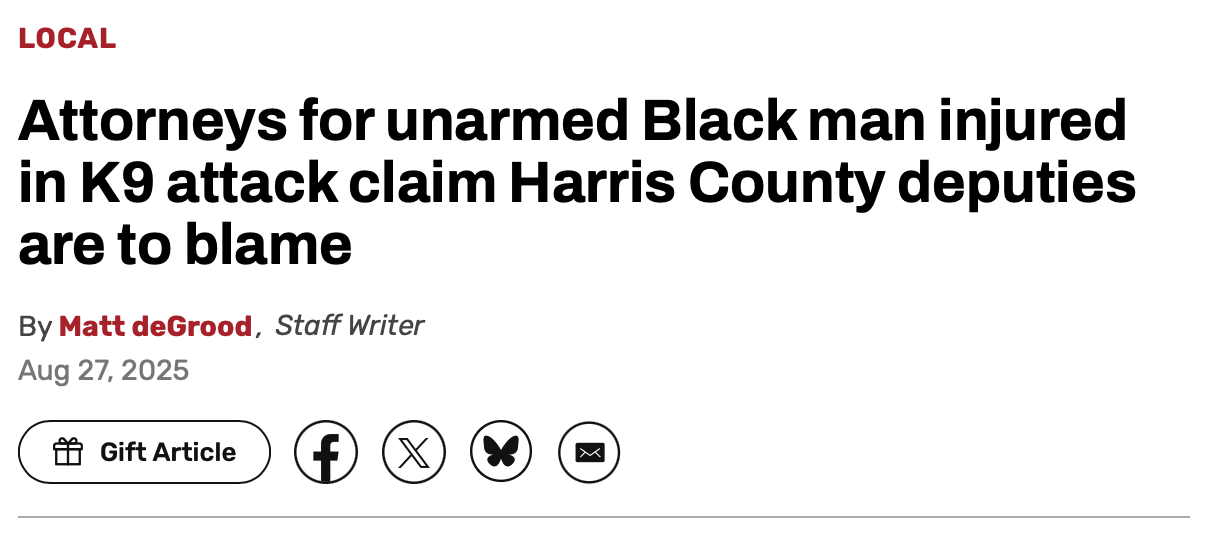
Mr. Thomas is a 36-year-old Black man and loving father of three girls who suffered a police dog mauling initiated by members of the Harris County Constable’s Office (Precinct 1). At the time of the attack, Mr. Thomas was lying prone on the ground with his hands outstretched and clearly visible. He was unarmed.

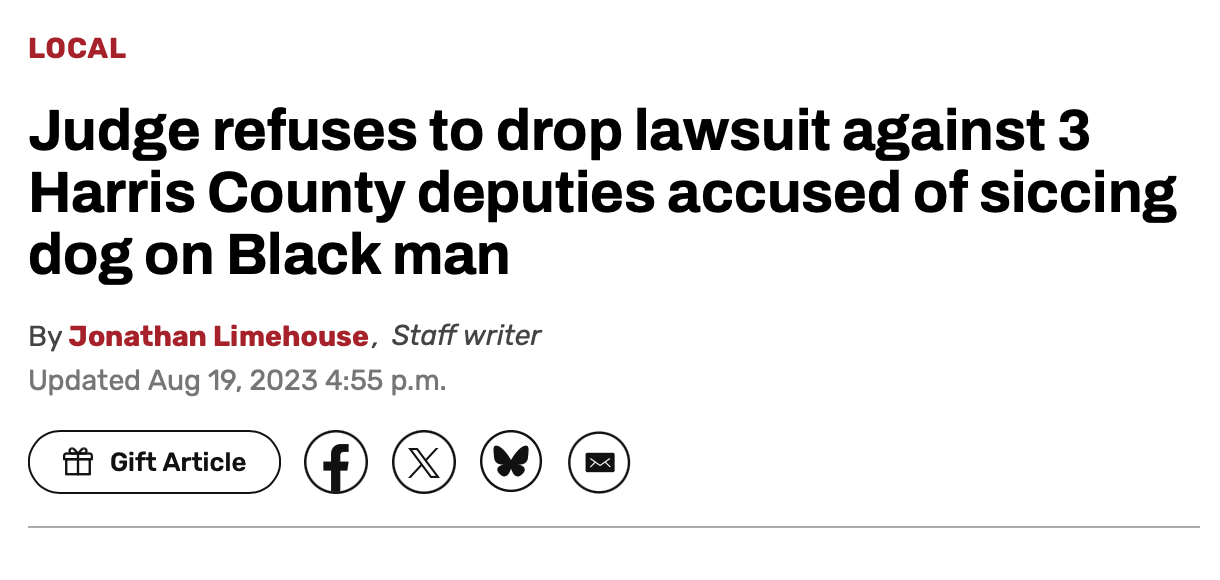
On February 22, 2023, Peoples’ Counsel attorneys filed a civil rights lawsuit in federal court to hold Sergeant Robert Johnson, Deputy Eric M. Bruss, and Deputy Wayne Schultz responsible for violating Mr. Thomas’s Fourth Amendment right to be free from excessive force.
FEB 2023 | MR. THOMAS SUES FOR EXCESSIVE FORCE
FROM THE COMPLAINT:
“On February 22, 2021, Sergeant Robert Johnson of the Harris County Constable’s Office (Precinct 1) ordered his police dog to attack Mr. Thomas while he lay prone on the ground with his hands outstretched and clearly visible. Mr. Thomas made no attempt whatsoever to flee, fight back, or resist. He was unarmed.
Just steps away, Defendant Deputy Eric M. Bruss and Defendant Sergeant Wayne Schultz stood, watching. Not only did they fail to stop Johnson, they helped him: aiming a gun on Mr. Thomas, taunting and threatening him, and lying after the fact to cover up their unjustified and unlawful conduct.”

AUG 2023 | COURT DENIES OFFICERS’ MOTION TO DISMISS
PEOPLES’ COUNSEL BLOCKS QUALIFIED IMMUNITY
FROM THE COURT’S OPINION:
“The court does not understand the reason for commanding a police dog to bite and severely injure a suspect, the subject of a noise complaint, who had been compliant, prone, and visibly unarmed for four minutes.”
“Bruss and Schultz made no attempt to deescalate the situation, even after the driver had been taken into custody and Thomas was lying face down on the ground. They had the opportunity to tell Johnson that they would help handcuff Thomas and that he did not need to carry out his threats to release the dog. They knew that Johnson was repeatedly threatening to use the dog against a suspect who had at most been too slow to stand up from a prone position when ordered to do so. Once the dog had been released, neither Bruss nor Schultz told Johnson to order the dog released in the seconds. Any of these actions may have prevented or at least lessened the injury caused by Johnson’s release of the dog.”
DEC 2025 | COURT DENIES OFFICERS’ MOTION FOR SUMMARY JUDGMENT
PEOPLES’ COUNSEL BLOCKS QUALIFIED IMMUNITY FOR THE SECOND TIME
FROM THE COURT’S OPINION:
“The record is clear that Johnson used constitutionally excessive force on Thomas. See Graham v. Connor, 490 U.S. 386, 396 (1989) (identifying the factors used to assess whether an officer used excessive force).”
“When Johnson released his dog, Thomas posed no threat to any officer. He was prone, with his arms outstretched, trying to comply with officers’ shouted commands, with no sign of access to a firearm. The Fifth Circuit has “consistently held that a suspect does not pose an immediate threat where he unambiguously surrenders by, for example, placing his hands in the air and complying with the officers’ commands.”
“Bruss and Schultz knew these facts….A reasonable jury could find that the officers had enough time to realize that using a police dog to attack a passively resisting suspect, clearly not in a position to or attempting to flee or shoot, was clearly excessive.”
CURRENT STATUS
Trial is currently set for the spring of 2025.
Revisit this page for updates.